Foothill Aquifer Water Hardness: Do You Need a Softener in Altadena?
Local foothill aquifer water has moderate to higher hardness depending on which provider serves your address. Here's what that does to your home and how to decide if a softener is worth it.
If you've noticed white scaly buildup on your showerheads and faucets, soap that doesn't lather well, water spots that don't wipe clean from glasses, or a water heater that's not lasting as long as it should, the local water hardness is the likely cause. The SGV foothill aquifer water has measurable hardness, and over time it affects fixtures, appliances, and the overall plumbing system.
The question isn't whether the water is hard; it is, to varying degrees depending on which provider serves your address. The question is whether the effects are bad enough to justify installing a water softener. For some households the answer is clearly yes. For others, the cost and ongoing maintenance of a softener doesn't pay off relative to the impact.
How hard the local water actually is
Water hardness is measured in grains per gallon (gpg) or milligrams per liter (mg/L). Water is generally classified as:
Soft: 0-3.5 gpg (0-60 mg/L). Soft water lathers easily with soap, leaves no scale, and is rare in California.
Moderately hard: 3.5-7 gpg (60-120 mg/L). Light scale formation over time, slight effect on soap performance.
Hard: 7-10.5 gpg (120-180 mg/L). Noticeable scale formation, reduced soap performance, water heater scaling over years.
Very hard: 10.5+ gpg (180+ mg/L). Significant scale formation, noticeable effects on fixtures and appliances.
The SGV foothill aquifer water served by local providers typically tests in the 7-15 gpg range depending on source mix and provider. That's hard to very hard. Specific providers and their typical hardness ranges:
Lincoln Avenue Water Company (much of west Altadena): historically tests in the higher end of the range, sometimes 12-15 gpg.
Las Flores Water Company (much of east Altadena): similar range, typically 10-14 gpg.
Pasadena Water and Power (Pasadena and south Altadena border): blends local groundwater with imported MWD water; hardness varies but typically 8-12 gpg.
Crescenta Valley Water District (La Crescenta, Montrose): typically 10-13 gpg.
For your specific address, you can request a water quality report from your provider. Most publish annual Consumer Confidence Reports that list hardness among other parameters.
What hardness actually does
Hard water has several effects on plumbing systems and household use.
Scale buildup on fixtures. Calcium and magnesium minerals precipitate out of solution when water evaporates or is heated. Visible white scaly deposits on showerheads, faucets, and shower glass are the most obvious sign. Aesthetic issue mostly; doesn't damage anything structurally.
Reduced soap and detergent performance. Hard water minerals react with soap to form scum, reducing lather and effectiveness. Households on hard water typically use 20-40% more soap, shampoo, and detergent than households on soft water for equivalent cleaning.
Water heater scaling. Hot water deposits scale on heating elements (in electric water heaters) and inside tank linings. Scale insulates the heating surface, reducing efficiency, and accumulates on the tank bottom where it can cause noise and reduce capacity. Hard water shortens water heater life by 25-50% in heavily affected systems.
Reduced fixture life. Cartridges, valves, and trim in faucets and showers wear faster on hard water as scale interferes with moving parts. Typical fixture cartridge life drops from 10-15 years to 5-8 years on hard water.
Reduced appliance life. Dishwashers, washing machines, ice makers, and any appliance with internal water heating or moving water parts see similar life reduction from hard water exposure.
Dishes and glassware spotting. Mineral residue on rinse water leaves spots when it dries. Aesthetic issue.
What a water softener actually does
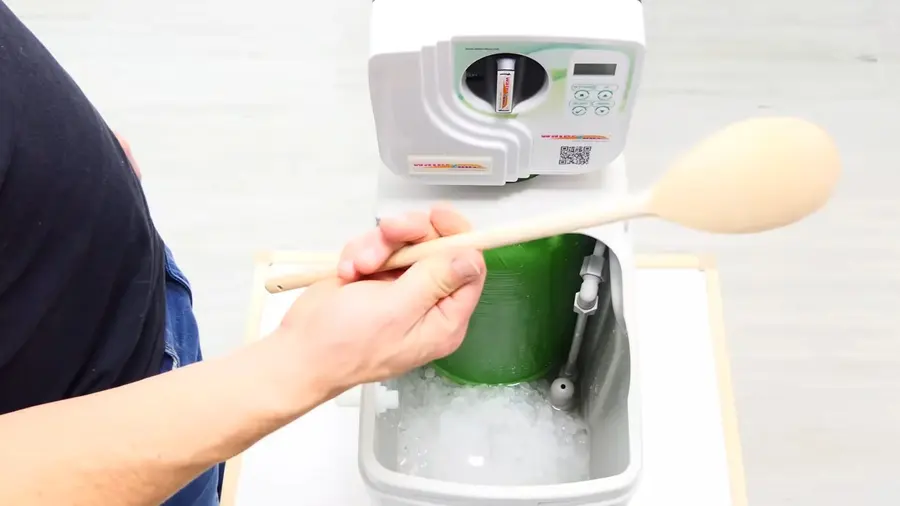
A whole-house water softener uses ion exchange to remove calcium and magnesium minerals from the water supply. Hard water flows through resin beads that swap the calcium and magnesium ions for sodium ions. Softened water comes out the other side with essentially zero hardness.
Periodically (typically every few days for a household), the resin needs to regenerate. The unit flushes itself with concentrated salt water (brine) that strips the calcium and magnesium off the resin and washes them down the drain. Regeneration takes 1-2 hours and uses 30-50 gallons of water plus 5-8 pounds of salt.
Salt consumption for a typical household runs 40-80 pounds per month. Salt cost is modest ($10-$25/month). Water consumption for regeneration adds 200-400 gallons/month to household water use.
Cost analysis for softener installation
Whole-house water softener installation runs $1,800-$3,500 in the SGV for a typical residential system. Includes the softener unit, brine tank, plumbing connections to the main supply line, electrical connection, and installation. Higher-end systems with twin tanks (for continuous operation) or smart controls run $3,500-$5,500.
Annual operating cost is $150-$300 for salt plus the additional water consumption for regeneration. Add roughly $200/year for filter replacement and maintenance on most systems.
Benefits offset by softener: extended water heater life (saves $1,500-$3,000 over the heater's lifespan), reduced soap and detergent use (saves $200-$500/year), extended fixture life (saves $200-$500/year), and extended appliance life on dishwashers and washers.
For typical SGV households with measurable hard water effects, the financial payback on a water softener is 5-8 years. Net financial benefit over the softener's 15-20 year lifespan is meaningful but not dramatic.
Alternatives to traditional softeners
Two alternatives address hardness with different tradeoffs.
Salt-free conditioners use template-assisted crystallization or similar technology to alter the form of hardness minerals so they don't precipitate as scale. The minerals are still in the water but they don't form scale on surfaces. Conditioners don't soften water in the strict sense (hardness measurement doesn't change), but they significantly reduce scale formation. Cost is similar to softeners; no salt or regeneration needed; lower maintenance. Effectiveness varies by water condition and household use patterns.
Combined softener and whole-house filtration adds a carbon filter and sediment filter to a softener for combined hardness, chlorine, and sediment treatment. Useful for households who want a single integrated solution. Cost runs $2,500-$4,500 installed.
For drinking water specifically, a reverse osmosis (RO) system at the kitchen sink provides much higher-quality drinking water than softener alone and addresses the mild taste change some homeowners notice from softened water.
Who should install a softener
The clearest cases for installing a softener:
Households with measurable hard water effects: visible scale on fixtures within months of cleaning, water heater that's not lasting as long as expected, fixtures that wear out faster than they should.
Long-term ownership of the home: 10+ year planning horizon makes the financial math work clearly.
Larger households with high water use: hard water effects scale with use, and benefits scale similarly.
Households planning major appliance purchases: protecting new dishwashers, washers, and water heaters from hardness damage extends their lives meaningfully.
Who can skip the softener
Smaller households or short ownership horizons may not see enough benefit to justify the upfront cost and ongoing maintenance.
Households whose water actually tests on the lower end of the hardness range (more common in southern Pasadena and other areas with more MWD blending) may not need full softening.
Households where the cosmetic effects don't bother anyone and major appliances are recently replaced may reasonably defer softener installation until other plumbing or appliance work creates a natural integration point.
For specific assessment of your home's water and recommendations on whether water softener installation, filtration, or a combined system makes sense, call (626) 687-0217.